
Online since 2002. The most comprehensive site for all around twisty puzzles.
|
Other Puzzles: Other Mechanisms
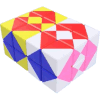 2x2x2x3 (4D)A hypercuboid made with a similar mechanism to the 2x2x2x2 4D
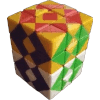 2x2x3x3 (4D)A hypercuboid modeled after the inventor's own 2x2x2x3 and Melinda's 2^4.
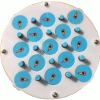 3x3 Clock plusA customly enhanced version of Rubik's Clock.
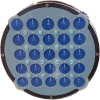 5x5 ClockA larger version of Rubik's Clock with 25 clocks in a square pattern and 16 knobs.
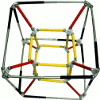 AbyssA puzzle which is based on the fourth dimensional symmetry (edge-transitivity) of the 4D polytope 8-cell (also known as Hypercube or Tesseract)
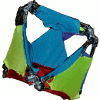 AfroditeA puzzle which is based on the fourth dimensional symmetry (edge-transitivity) of the 4D polytope rectified 5-cell (also known as Tetroctahedric)
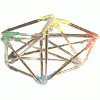 ArgoA puzzle which is based on the sixth dimensional symmetry of the 6-Simplex.
 Bandaged BrainballBrainballs with several pieces glued together. There are 12 meaningful variants. 6 are implemented here.
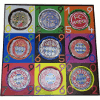 Bayern München ClocksA set of nine Rubik's Clocks with custom made layout. All show one of the badges from the history of soccer club "FC Bayern München"
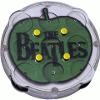 Beatles ClockTwo customized variants of Rubik's Clocks with motives depicting the Beatles.
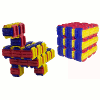 Bishop CubesA set of 27 interlocking cubes which is not scrambled by colour but by shape.
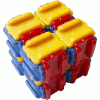 Bishop Cubes (2x2x2)The smaller version of the Bishop Cubes. A set of 8 interlocking cubes which is not scrambled by colour but by shape.
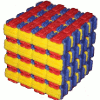 Bishop Cubes (4x4x4)The bigger version of the Bishop Cubes. A set of 64 interlocking cubes which is not scrambled by colour but by shape.
 Boomdas4Sixteen pieces in a 2D puzzle almost arbitrarily shiftable against each other.
 Brain BlenderA put-together puzzle composed of 5 twisty pieces.
|
|